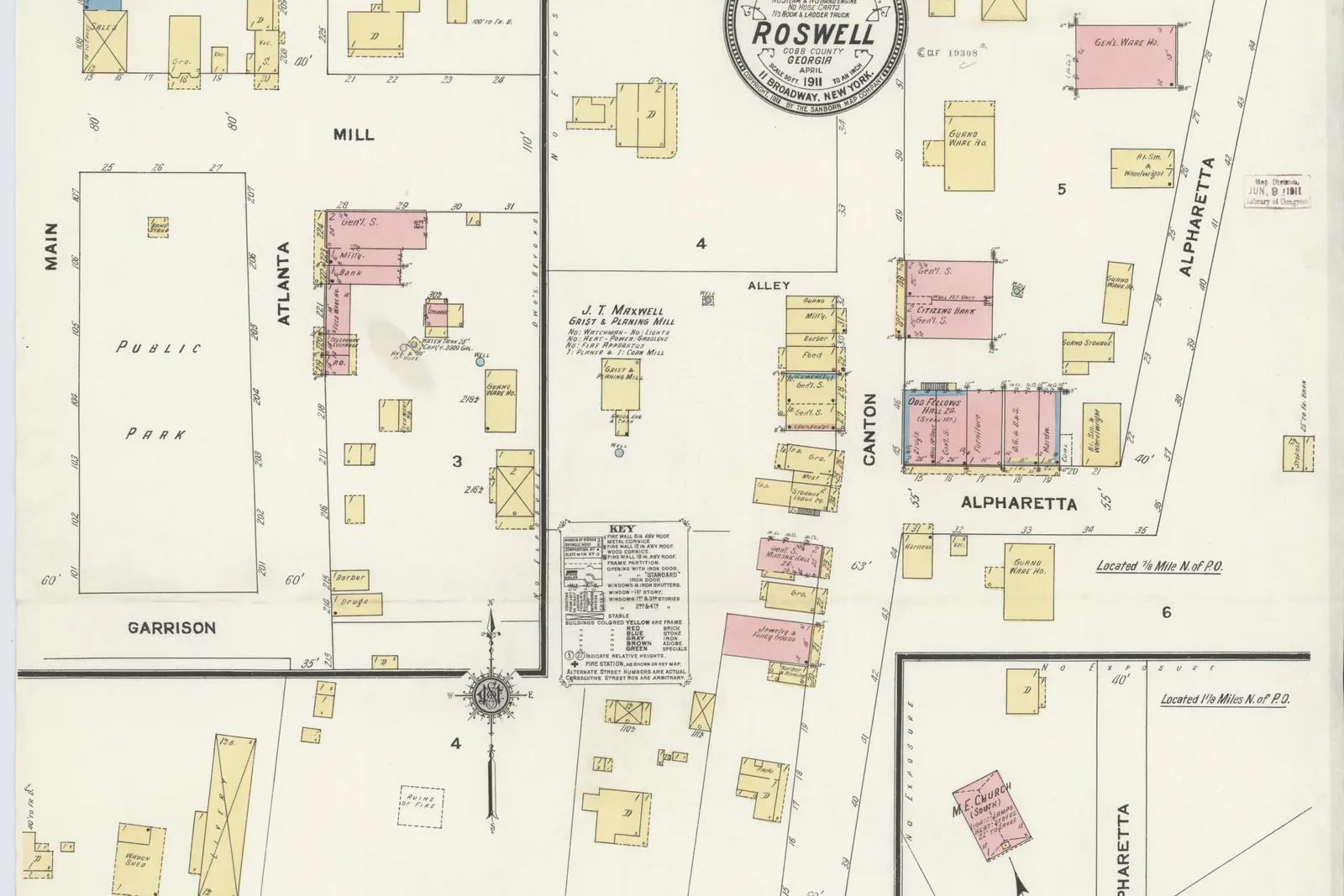
This is the history of Roswell in Fulton County, Georgia, on the Chattahoochee River. Every date below comes from a named source, mostly the New Georgia Encyclopedia, Visit Roswell (the city’s visitors bureau) and the National Park Service. Where two sources differ, we say so. The town began in Cobb County; the New Georgia Encyclopedia says it was annexed to Fulton County in 1932.
- Roswell is a city in Fulton County, Georgia, on the Chattahoochee River north of Atlanta. The New Georgia Encyclopedia puts it twenty miles north of Atlanta. This is Roswell, Georgia, not Roswell, New Mexico. New Georgia Encyclopedia: Roswell (last modified Sep 4, 2019)
- The New Georgia Encyclopedia says Roswell was originally in Cobb County and was annexed to Fulton County in 1932. New Georgia Encyclopedia: Roswell (last modified Sep 4, 2019)
Roswell King and the waterpower, 1828 to 1839
The New Georgia Encyclopedia says Roswell King came into the Cherokee “gold country” after gold was found there in 1828, and saw the waterpower where the Chattahoochee River meets Vickery Creek, which it also calls Big Creek. In the mid-1830s he and his sons Barrington and Ralph built a textile mill complex. It was incorporated in 1839 as the Roswell Manufacturing Company. Visit Roswell’s timeline says the company’s first cotton mill opened in 1839.
- The New Georgia Encyclopedia says Roswell King came to the Cherokee "gold country" after gold was found there in 1828, and saw the waterpower at the meeting of the Chattahoochee River and Vickery (Big) Creek. New Georgia Encyclopedia: Roswell (last modified Sep 4, 2019)
- In the mid-1830s Roswell King and his sons Barrington and Ralph built a textile mill complex that was incorporated in 1839 as the Roswell Manufacturing Company, in what was then Cobb County (New Georgia Encyclopedia). New Georgia Encyclopedia: Roswell (last modified Sep 4, 2019)
- Visit Roswell's Civil War page says the first cotton mill of the Roswell Manufacturing Company opened in 1839. Visit Roswell (Roswell CVB): Civil War
A planned town and the families who built it
The Kings did not come alone. The New Georgia Encyclopedia names five other coastal families, the Bullochs, Dunwodys, Lewises, Pratts and Smiths, and says together they built mansions, a town square, a company store, a mill village, a Presbyterian church and an academy. Roswell King died in 1844. The town was incorporated in 1854.
- The New Georgia Encyclopedia says the Kings and five other coastal families, the Bullochs, Dunwodys, Lewises, Pratts and Smiths, built mansions, a town square, a company store, a mill village, a Presbyterian church and an academy. New Georgia Encyclopedia: Roswell (last modified Sep 4, 2019)
- Roswell King died in 1844, and the town of Roswell was incorporated in 1854, according to the New Georgia Encyclopedia. New Georgia Encyclopedia: Roswell (last modified Sep 4, 2019)
Two pieces of that plan survive. Visit Roswell says the Roswell Presbyterian Church sanctuary at 755 Mimosa Blvd. was built in 1840 and calls it the oldest public building in Roswell. The Roswell Ghost Tour describes Founders Cemetery as Roswell King’s burial site.
- Visit Roswell says the Roswell Presbyterian Church historic sanctuary at 755 Mimosa Blvd. was built in 1840, calls it the oldest public building in Roswell, and says it was used as a hospital for Union soldiers during the Civil War. Visit Roswell (Roswell CVB): Historic Sites
- The Roswell Ghost Tour says its route visits Founders Cemetery, which it describes as the burial site of Roswell King. Roswell Ghost Tour (operator site)
Slavery in early Roswell
The planter families who founded Roswell held people in slavery, and the sources say so directly. Visit Roswell says Archibald Smith came to Roswell in 1845 with his wife, his children and thirty enslaved people, and built a home on a plantation of more than 300 acres. At Bulloch Hall, Visit Roswell says the reconstructed service grounds include slave cabins, and one cabin holds exhibits on the role of African Americans in Roswell’s history.
- Visit Roswell says Archibald Smith came to Roswell in 1845 with his wife, children and thirty enslaved people, built a home on a plantation of more than 300 acres, and that his descendants sold the home to the City of Roswell in 1986. Visit Roswell (Roswell CVB): Historic Home Tours
- Visit Roswell says the couple wed at Christmas time in 1853, and that the reconstructed service grounds at Bulloch Hall include slave cabins and a carriage house, with one cabin used for exhibits on the role of African Americans in Roswell's history. Visit Roswell (Roswell CVB): Historic Home Tours
What our sources do not give is a count of the enslaved people in Roswell as a whole, or an account of their work inside the mills. We have left those out rather than guess. The Roswell History Museum, run by the Roswell Historical Society, covers the enslaved alongside mill workers and farmers in its exhibits. The City’s Roswell Roots festival of Black history and culture ran its 25th year from Jan. 19 to Feb. 28, 2026.
- Visit Roswell says the Roswell Historical Society runs the Roswell History Museum on the second floor of 950 Forrest Street, open Wednesday to Saturday, 11 a.m. to 3 p.m., free. Visit Roswell (Roswell CVB): Historic Sites
The mill before the war
By 1860, the New Georgia Encyclopedia says, the Roswell Manufacturing Company made cotton cloth, yarn, rope and tenting and was the largest cotton mill in north Georgia. The National Park Service says the Ivy Mill, part of the Roswell Mill group near the mouth of Big Creek, made cotton and wool, including the “Roswell Gray” used for Confederate uniforms.
- By 1860, the New Georgia Encyclopedia says, the Roswell Manufacturing Company made cotton cloth, yarn, rope and tenting and was the largest cotton mill in north Georgia. New Georgia Encyclopedia: Roswell (last modified Sep 4, 2019)
- The National Park Service says the Ivy Mill ruins, part of the Roswell Mill group, stand near the mouth of Big Creek in the Vickery Creek Unit, and that the mill made cotton and wool, including the "Roswell Gray" used for Confederate uniforms. National Park Service: Ivy Mill Ruins
July 1864: the mills burn and the workers are sent north
Visit Roswell’s timeline says Union troops arrived from Marietta on July 5, 1864, and destroyed the Roswell Manufacturing Company on July 6. The New Georgia Encyclopedia says Sherman approved destroying the mills and ordered more than 400 mill workers, mostly women, charged with treason and sent north.
- Visit Roswell's Civil War timeline says Union troops arrived in Roswell from Marietta on July 5, 1864, and destroyed the Roswell Manufacturing Company on July 6. Visit Roswell (Roswell CVB): Civil War
- The New Georgia Encyclopedia says Sherman approved destroying the mills and ordered more than 400 mill workers, mostly women, charged with treason and sent north. They and their children went by wagon to Marietta, then by train toward Louisville, Kentucky; many were sent on to Indiana. New Georgia Encyclopedia: Roswell (last modified Sep 4, 2019)
Visit Roswell gives the dates. The workers and their children were taken by wagon to Marietta on July 10, held at the Georgia Military Academy, and put on trains north on July 15. The New Georgia Encyclopedia says the trains went toward Louisville, Kentucky, and that many were sent on to Indiana. Before they left, Visit Roswell says, they were held overnight under guard on the Town Square. A monument to the mill women and children now stands in the park on Sloan Street. The Presbyterian church, Visit Roswell says, was used as a hospital for Union soldiers.
- Visit Roswell says the mill workers were sent by wagon to Marietta on July 10, 1864, held at the Georgia Military Academy, and put on trains north on July 15. Visit Roswell (Roswell CVB): Civil War
- Visit Roswell lists Roswell Town Square at 610 Atlanta Street and says the 400 mill workers were held there overnight under guard in 1864, and that President Theodore Roosevelt visited the square and Bulloch Hall. Visit Roswell (Roswell CVB): Historic Sites
The two main sources count the workers slightly differently: the New Georgia Encyclopedia says “more than 400” and Visit Roswell says 400.
Rebuilding, and the end of milling
After the war, the New Georgia Encyclopedia says, one cotton mill and the woolen factory were rebuilt, and a second cotton mill went up in 1882. The last mill burned in 1926, was rebuilt, and ran as Southern Mills from 1947 to 1975. Visit Roswell calls the two-story Machine Shop the only surviving building of the 1839 company; it is now an events facility, and a trail beside it leads to the ruins.
- After the war one cotton mill and the woolen factory were rebuilt, and a second cotton mill was built in 1882. The New Georgia Encyclopedia says the last mill burned in 1926, was rebuilt, ran as Southern Mills from 1947 to 1975, and the mill ruins are now a historic site. New Georgia Encyclopedia: Roswell (last modified Sep 4, 2019)
- Visit Roswell calls the Machine Shop, a two-story late Georgian building, the only existing building of the 1839 Roswell Manufacturing Company. The CVB says it is now an events facility, and the interpretive trail beside it leads to the mill ruins and the waterfall made by the dam. Visit Roswell (Roswell CVB): Historic Sites
The Roosevelt connection
In 1853 Martha “Mittie” Bulloch married Theodore Roosevelt Sr. at Bulloch Hall, her childhood home. Their son became President Theodore Roosevelt. Visit Roswell says the wedding was at Christmas time and that the president later visited the Town Square and Bulloch Hall.
- In 1853 Martha "Mittie" Bulloch and Theodore Roosevelt Sr., the parents of President Theodore Roosevelt, were married at Bulloch Hall, Mittie's childhood home in Roswell (New Georgia Encyclopedia). New Georgia Encyclopedia: Roswell (last modified Sep 4, 2019)
The Historic District listing, 1974
The Roswell Historic District is on the National Register of Historic Places as NRIS 74000682. The National Park Service’s NPGallery record gives the date as May 2, 1974, and describes the district as roughly bounded by Big Creek, King and Dam Streets, and southwest along New Marietta Highway. Bulloch Hall had been listed on its own three years earlier, on May 27, 1971.
- The Roswell Historic District is on the National Register of Historic Places as NRIS 74000682. The NPGallery record gives the date 5/2/1974 and the location as roughly bounded by Big Creek, King and Dam Streets, and southwest along New Marietta Highway. NPS NPGallery: Roswell Historic District, NRIS 74000682
- Bulloch Hall is listed on the National Register as NRIS 71000276. The NPGallery record gives the date 5/27/1971, Greek Revival style, architect Willis Ball and significant year 1840. NPS NPGallery: Bulloch Hall, NRIS 71000276
Timeline at a glance
- 1828: gold is found in the Cherokee country; Roswell King arrives after it (New Georgia Encyclopedia).
- 1839: the Roswell Manufacturing Company is incorporated and its first cotton mill opens (NGE; Visit Roswell).
- 1844: Roswell King dies. 1845: Archibald Smith arrives with thirty enslaved people (Visit Roswell).
- 1853: Mittie Bulloch marries Theodore Roosevelt Sr. at Bulloch Hall. 1854: Roswell is incorporated.
- July 5 to 15, 1864: Union troops arrive, burn the mills and send the mill workers north.
- 1882: a second cotton mill is built. 1926: the last mill burns and is rebuilt.
- 1932: Roswell moves from Cobb County to Fulton County. 1947 to 1975: Southern Mills.
- 1971: Bulloch Hall is listed on the National Register. 1974: the Roswell Historic District is listed.
The City’s Youth Day dates from 1950, and its listing says that in 1951 Mayor Ford Rucker proclaimed the second Saturday in October as Roswell Youth Day. The 2020 Census counted 92,833 people in the city.
- The City's Youth Day listing says the tradition began in 1950, and that in 1951 Mayor Ford Rucker proclaimed the second Saturday in October as Roswell Youth Day. The 2026 celebration was Saturday, October 3, with the Frances McGahee Parade from 10 to 11 a.m. Youth Day Celebration 2026, hosted by City of Roswell (Eventeny listing)
- The 2020 Census counted 92,833 people in the city of Roswell, Georgia. U.S. Census Bureau, 2020 Census Redistricting Data (P.L. 94-171), Table P1, Roswell city, Georgia
See the history in person
Start at the mill ruins and covered bridge, then walk to the Town Square and the three house museums, which are free Friday to Sunday. The City’s History Seek walking tour on Saturday, Nov. 7, 2026, from 1 to 2:30 p.m., covers the planned mill town, the church and the planters’ homes; it costs $12 and needs advance registration (Roswell365 listing). The day planner puts the stops in order, and things to do covers the rest of downtown.
History questions
What county is Roswell in?
Roswell is in Fulton County. The New Georgia Encyclopedia says the town was originally part of Cobb County and was annexed to Fulton County in 1932. The 2020 Census counted 1,066,710 people in Fulton County as a whole and 92,833 in the city of Roswell.
Source: New Georgia Encyclopedia: Roswell (last modified Sep 4, 2019)
Who founded Roswell, Georgia?
The New Georgia Encyclopedia says Roswell King came to the Cherokee gold country after 1828 and saw waterpower potential where Vickery (Big) Creek meets the Chattahoochee. In the mid-1830s he and his sons Barrington and Ralph built a textile mill complex, incorporated in 1839 as the Roswell Manufacturing Company. The town, named for him, was incorporated in 1854, ten years after his death.
Source: New Georgia Encyclopedia: Roswell (last modified Sep 4, 2019)
When was Roswell incorporated?
The New Georgia Encyclopedia says the town of Roswell was incorporated in 1854. The mill company came first: the Roswell Manufacturing Company was incorporated in 1839, in what was then Cobb County. Roswell King died in 1844, so he did not see the town named for him become official.
Source: New Georgia Encyclopedia: Roswell (last modified Sep 4, 2019)
What happened to the Roswell mills in the Civil War?
Visit Roswell's timeline says Union troops reached Roswell from Marietta on July 5, 1864, and destroyed the Roswell Manufacturing Company on July 6. The New Georgia Encyclopedia says Sherman approved destroying the mills. After the war one cotton mill and the woolen factory were rebuilt, and a second cotton mill went up in 1882.
What happened to the Roswell mill workers in 1864?
The New Georgia Encyclopedia says more than 400 mill workers, mostly women, were charged with treason and sent north with their children. They went by wagon to Marietta and then by train toward Louisville, Kentucky, and many were sent on to Indiana. Visit Roswell says they were held overnight on the town square, and a monument to them stands in the park on Sloan Street.
Source: New Georgia Encyclopedia: Roswell (last modified Sep 4, 2019)
Can you see the old Roswell mill ruins?
Yes. Visit Roswell says the ruins of the Roswell Manufacturing Company mills lie along the Old Mill Trail on Vickery Creek, near a 30-foot dam and millrace. An interpretive trail beside the Machine Shop at Old Mill Park, 95 Mill Street, leads to the ruins and the waterfall. The National Park Service also protects the Ivy Mill ruins near the mouth of Big Creek.
What is Roswell Gray?
The National Park Service says the Ivy Mill, part of the Roswell Mill group on Big Creek, made cotton and wool, including a blend known as Roswell Gray that was used to make Confederate uniforms during the Civil War. The Ivy Mill ruins stand near the mouth of Big Creek in the Vickery Creek Unit of the Chattahoochee River National Recreation Area.
Is downtown Roswell on the National Register of Historic Places?
Yes. The Roswell Historic District is listed as NRIS 74000682. The National Park Service's NPGallery record gives the date as May 2, 1974, and describes the area as roughly bounded by Big Creek, King and Dam Streets, and southwest along New Marietta Highway. Bulloch Hall has its own listing, NRIS 71000276, dated May 27, 1971.
Source: NPS NPGallery: Roswell Historic District, NRIS 74000682
Which historic houses can I tour in Roswell?
The City owns and runs three house museums: Barrington Hall at 535 Barrington Drive, Bulloch Hall at 180 Bulloch Drive and Archibald Smith Plantation at 935 Alpharetta Street. Admission is free. The City lists hours of Friday and Saturday 11 a.m. to 4 p.m. and Sunday 1 to 4 p.m. Visit Roswell says Smith Plantation is closed for repairs, so check first.
Is Bulloch Hall free, and when is it open?
The City says admission to Bulloch Hall is free. Museum hours are Friday and Saturday 11 a.m. to 4 p.m. and Sunday 1 to 4 p.m., and the grounds are open daily from sunrise to sunset. The City suggests arriving by 3:15 p.m. because buildings close at 4 p.m. Its page also says closed Monday through Wednesday in one place, so check closures.
What is the Theodore Roosevelt connection to Roswell?
Bulloch Hall was the childhood home of Martha "Mittie" Bulloch. The New Georgia Encyclopedia says she married Theodore Roosevelt Sr. there in 1853; their son became President Theodore Roosevelt. Visit Roswell says the wedding was at Christmas time and that the president later visited the town square and his mother's childhood home.
Source: New Georgia Encyclopedia: Roswell (last modified Sep 4, 2019)
Who built Barrington Hall?
A New Georgia Encyclopedia caption says Barrington King, son of Roswell King, built Barrington Hall in 1842, and that it is on the National Register. Visit Roswell says the house stands on the highest point overlooking the town, with a smokehouse, ice house, barn and two wells on the grounds. The City runs it as a free house museum.
Source: New Georgia Encyclopedia: Roswell (last modified Sep 4, 2019)
What is the Archibald Smith Plantation?
Visit Roswell says Archibald Smith moved to Roswell in 1845 with his wife, children and thirty enslaved people and built a home on a plantation of more than 300 acres. His descendants sold the home to the City in 1986. The City lists it at 935 Alpharetta Street; Visit Roswell currently says the house is closed for repairs while the grounds stay open.
What is the oldest public building in Roswell?
Visit Roswell says the historic sanctuary of Roswell Presbyterian Church, 755 Mimosa Boulevard, was built in 1840 and calls it the oldest public building in Roswell. It also says the church served as a hospital for Union soldiers during the Civil War. Visit Roswell lists it with the other historic district sites, including the town square and the mill ruins.
How long has the Roswell Farmers Market been running?
The market says it started in 2007 as a small effort at Riverside Park. It later moved to the Hill Street side of City Hall, then to a lower lot near the bridge, then to the Roswell Presbyterian Church driveway, before returning to City Hall. Its site dates the return to 2025, while a Visit Roswell interview says 2024. It runs as a nonprofit.
What is Roswell Youth Day?
The City's listing says Youth Day began in 1950 when parents organised a parade and activities to honor the city's youth, and that in 1951 Mayor Ford Rucker proclaimed the second Saturday in October as Roswell Youth Day. The 2026 celebration was held Saturday, October 3, with the Frances McGahee Parade from 10 to 11 a.m.
Source: Youth Day Celebration 2026, hosted by City of Roswell (Eventeny listing)
Dates, rules and hours can change. The organisers have the final word: City of Roswell